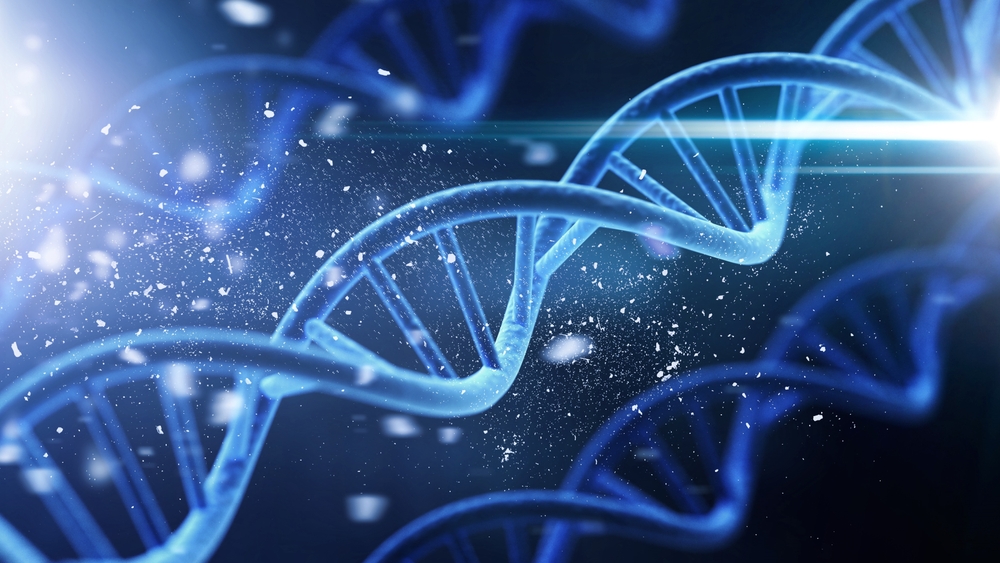
I am sure we’re all aware of the famous double helix structure, but how many of us have pondered over actually why DNA’s atoms are arranged like this? To do this, we need to pick apart the contributions to the overall free energy change (a measure of the amount of usable energy in a system1) as you go from the unfolded state (single, separate strands) to the folded state (the double helix) in order to determine which is favourable. We will look at several properties that affect this.
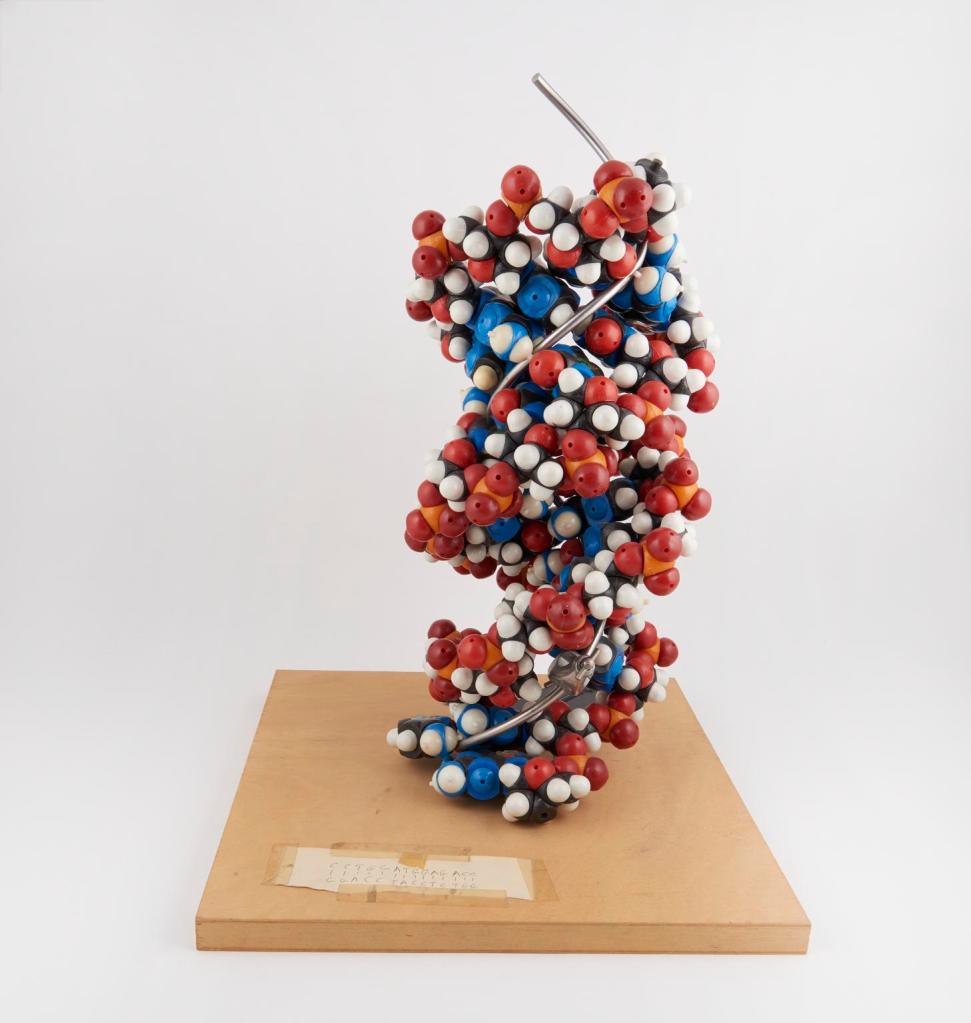
© The Board of Trustees of the Science Museum
Repulsion between negatively charged phosphate groups:
DNA is made up of a backbone consisting of sugar molecules and phosphate groups. These phosphate groups are negatively charged. However, in the double helix structure, these groups are forced together, resulting in a significant increase in the proximity of these groups that repel one another, causing the repulsive forces between these phosphates to also increase. This is unfavourable and increases free energy.
Loss of translational and rotational freedom:
DNA’s backbone is also exclusively made of single bonds, which allows for a great deal of rotational freedom and different spacial arrangements when in its unfolded state. When in the double helical structure, the backbone’s freedom of movement is highly restricted, which causes free energy to increase again because this is unfavourable.
Hydrogen bonds between bases:
Apart from the backbone, DNA also consists of nitrogenous bases. These four bases have flat, aromatic ring structures and a great deal of hydrogen bonding potential (they have lots of nitrogens and oxygens which have lone pairs). In the double helix, the complementary bases adenine and thymine, and cytosine and guanine form hydrogen bonds with each other – the hydrogen bonding potential is realised. In the unfolded state, the bases will form hydrogen bonds with water surrounding the molecule instead. This means that the formation of hydrogen bonds doesn’t make much contribution to the stability of the double helix, because one set of hydrogen bonds is replaced with another. This results in the free energy not changing.
Base pair stacking – intermolecular forces:
Because the bases are aromatic and flat structures, they have an ability to stack very effectively one on top of the other to form a very densely packed core of the double helix. Between the bases, induced dipole-dipole forces form due to their nonpolar nature. In the unfolded state, these forces cannot form because the bases are not near each other. The formation of these intermolecular forces increases the stability of the double helix dramatically, which decreases free energy significantly.
Base pair stacking – water arrangement:
In the unfolded state, the bases are highly exposed to water – this causes the water to be highly ordered around them (like cages) so that they can still form hydrogen bonds with each other. In the double helix, the bases are stacked, so they are not exposed to water. This means that water doesn’t need to be ordered so that it can form hydrogen bonds – it can move without restriction. This decreases free energy.
Water ordering in major and minor grooves:
However, water must instead fill up the major and minor grooves by becoming slightly ordered. This increases free energy slightly.
Overall, the free energy of the double helical state has slightly less free energy than the unfolded state – meaning it is more favourable. However, it is important that the folded state is not very stable. This is because DNA must be unfoldable, which is necessary in the processes of DNA replication and proteinsyntheis when the bases must be read.
Bibliography:
Phillip Evans (2020), Understanding DNA Structure 8: Summary [online]. Last accessed 14/03/2026: https://www.youtube.com/watch?v=_TKMSBOOmnI
References:
- Khan Academy (2015), Endergonic vs exergonic reactions [online]. Last accessed 14/03/2026: https://www.khanacademy.org/science/biology/energy-and-enzymes/free-energy-tutorial/a/gibbs-free-energy
 Molecular Perspective