
It is a well known fact that certain food items or chemicals can increase our chances of getting cancer – but why is this? A carcinogen is a substance, organism or agent capable of causing cancer – common examples include radiation, smoking, and alcohol1. Cancer is a disease in which some of the body’s cells grow uncontrollably and spread to other parts of the body2.
Some carcinogens cause direct damage to DNA, which potentially alters the proteins produced from translated genes, which may lead to a series of events that change a normal cell into a cancer cell3. This may involve single or double-strand breaks (breaks that occur in either one or both strands of DNA) and/or chemical DNA adducts (a piece of DNA that has bonded tightly to a chemical compound).
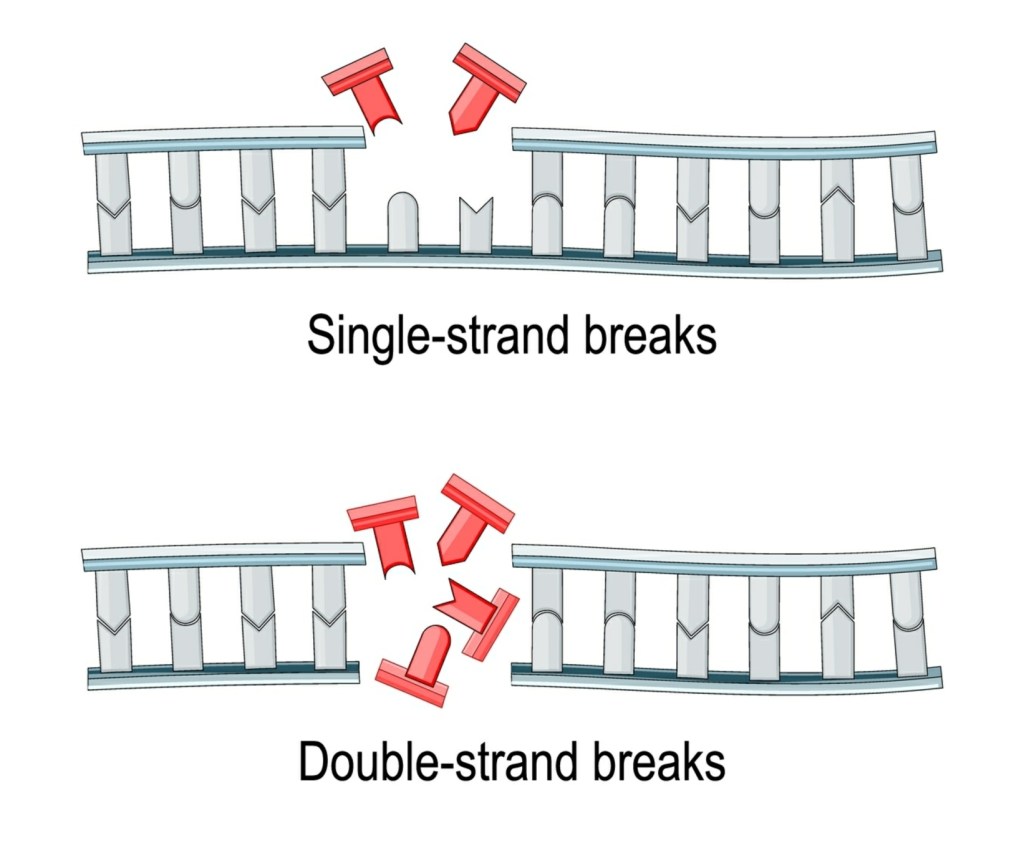
Carcinogens can cause breaks in DNA through binding directly to the phosphate-sugar backbone and taking away electrons from it. This is because they are highly unstable molecules, meaning they are attracted to electrons, so are called electrophiles. This weakens the structure of the backbone, therefore causing breaks. Also, carcinogens like UV or X-rays withhold enough energy to break the phosphodiester bonds within the backbone. Overall, breaks in the DNA strand causes consequences for the cell by blocking the path of RNA polymerase during protein synthesis, resulting in an mRNA strand that is truncated at the site of breakage4.
Strand breaks cause genomic instability that drives cancer development – they can cause loss or rearrangement of entire chromosomes in a cell5. This may result in, for example, the silencing of a tumour suppressing gene or the expression of a gene that controls cell division, which ultimately leads to tumour formation.
Other carcinogens may cause damage to processes that usually repair broken DNA. Every day, genetic information is copied incorrectly (about hundred thousand errors per cell division initially) Left unrepaired, damaged DNA may lead to mutations in certain genes, so cells recruit a number of processes to recognise and fix this, including programmed cell death (apoptosis). However, carcinogens can suppress the function of repair enzymes by causing their active site to change shape, and they can also deplete the resources used by the cell (e.g functioning proteins) by causing a constant exposure to genetic flaws.
Bibliography:
Khan Academy (2022), Carcinogens | Human Health and Disease. [Online] Last accessed 01/05/2026 https://www.youtube.com/watch?v=EHeVtJA2Uh8
References:
- National Human Genome Research Institute (2019), Carcinogen. [Online] Last accessed 01/05/2026 https://www.genome.gov/genetics-glossary/Carcinogen
- National Cancer Institute (2016), What is cancer? [Online] Last accessed 01/05/2026 https://www.cancer.gov/about-cancer/understanding/what-is-cancer
- Cleveland Clinic (2023), Carcinogens. [Online] Last accessed 02/05/2026 https://my.clevelandclinic.org/health/articles/25081-carcinogens
- Science Direct (2024), Causes and consequences of DNA single-strand breaks. [Online] Last accessed 30/04/2026 https://www.sciencedirect.com/science/article/pii/S0968000423002852
- National Library of Medicine (2024), DNA double-strand break repair pathway choice and cancer. [Online] Last accessed 01/05/2026 https://pmc.ncbi.nlm.nih.gov/articles/PMC4051845/

